(Also see Extrinsic Motivation)
There is no substitution for the investment that comes with a strong, positive classroom culture. Students learn when they are happy and feel good about themselves. If they are bitter, resentful, or lack self-confidence, they could miss learning opportunities because, as studies show, memory retention is lower when the endorphins stop flowing. Think about your own learning experiences. You probably don’t remember much from that dreary course you took in junior year of high school where the teacher may have instructed just fine, but failed to motivate and invest the class, and failed to make you feel successful, intelligent or valuable.
There is no substitution for the investment that comes with a strong, positive classroom culture. Students learn when they are happy and feel good about themselves. If they are bitter, resentful, or lack self-confidence, they could miss learning opportunities because, as studies show, memory retention is lower when the endorphins stop flowing. Think about your own learning experiences. You probably don’t remember much from that dreary course you took in junior year of high school where the teacher may have instructed just fine, but failed to motivate and invest the class, and failed to make you feel successful, intelligent or valuable.
Likewise, think about a teacher who
used sarcasm to make students feel poorly about themselves, who indirectly (or
directly) blamed students for the teacher’s own shortcomings, who gave out
mostly negative feedback and consequences, or who made frequent implied threats
toward the class (“If I don’t see everyone seated in 10 seconds you’re all
losing your recess”). Any one of these practices alone can create a poisonous
classroom culture—where students actively decide to avoid learning from such a
teacher as a way to reclaim power in the situation. Simply put, students will refuse to learn from a teacher who doesn’t
seem to actively value them.
As you work on investing your class
as a teacher, your end goal is to
invest students intrinsically—a sort
of deep, authentic buy-in that students exhibit when they work hard in order to
reach their short- and long-term academic goals, as opposed to being primarily
motivated by class points, candy, extra recess or pleasing the teacher. As
teachers, we are always looking to invest intrinsically by having kids write,
edit and finalize personal big goals at the start of the year, design
class-wide big goals, research colleges, or write letters introducing
themselves to their favorite universities, interact with guest speakers or
inspirational professionals from the local community, or watch videos that show
students at other schools modeling ultimate scholarly behavior. (“Most people
think that only private school students are capable of this! They think that
only top scholars at private schools
will go on to take the spots at top colleges and get hired at the top jobs! Do
you buy that?!”) The list of techniques goes on.
As a second year teacher, I
returned to school with an appreciation for how vital intrinsic investment is
to classwide success. I wanted to make sure to hook my students on our big
goals from the start, so I planned an investment unit for the beginning of the
year. I had my sixth graders fill in a graphic organizer that helped them
generate big goals in each of our
classes (Math, History, Reading and Writing) and then explain how these
year-long goals in each subject would help them reach their long-term big goals
(college, professions, lifestyles). I really wanted the goals to be specific,
relevant and attainable so I then pulled three or four students at a time
during lunch for “big goal brownie parties.” Party-going students adapted their
drafted goals into a final product, which they rewrote and decorated on index
cards. The big goals brownie parties really set the year off to a great start,
as did various investment readings and powerpoints that students
reviewed–teaching them stats about literacy rates, average income based on
educational attainment, and top universities.
What I still didn’t understand
is that one brief unit at the beginning of the year doesn’t buy year-long
investment from students. (Unfortunately, I figured this out the hard way
through class-culture stagnation midyear.) Not only should investment
mini-units, lessons and activities be interspersed throughout the year, the
teacher must also continually direct the students’ attention back to the class
and individual big goals through chants, cheers, progress parties, and
individual and class-wide big-goal progress-tracking. Optimally, students should
be able to explain class-wide and individual big goals to any visitor who came
into the classroom. If students aren’t familiar enough with their goals to do
that, the big goals you spent so much effort designing and setting into place at
the start of the year are probably not being used to their full potential.
Several concrete ideas to boost investment and keep students’ eyes on
the prize:
·
Build a chant into your schedule. Every Monday
morning, do a “meets and exceeds” (the big goals / state standards) chant to
kick off the week. Over time, have students lead the chant, or choose which big
goals chant to do, or design their own chants.
·
Use a chant to celebrate class-wide success on
assessments, or focus student energy right before students begin an assessment.
·
Assign students the job of updating
class-average trackers on assessments in different areas – displayed on large
posters. As a morning warm up, ask students to look for trends, or identify
steps the class could take to boost their scores etc.
·
Have students track their
test/quiz/project/essay scores on individual bar graph trackers that are
immediately collected or stored in a safe, designated place. Give them stickers
to place on the bars that exceed 80%, or whatever the class big goal is.
·
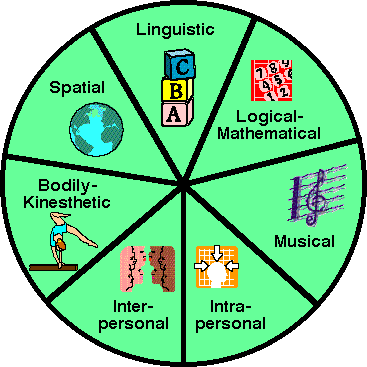
Help students appreciate their unique learning
strengths in school (think: multiple intelligences [learning styles]: see graphic
below). Plan lessons, activities and projects that demand different types of
output from students. Investment is also
always boosted when students are
given some sort of choice, either in what content they study, or what form
of output they get to use in showing what they have learned. You won’t be able
to do this for every lesson, but it will be useful to keep in mind for those
activities where more leeway in content/output can be given.
·
Help students come to see themselves as top scholars in the sense that it becomes the core of their
in-school identity (as opposed to identifying themselves primarily as football
players, fashionistas, cartoon-viewers, class clowns, popular kids in class, artists
etc.)
o
Take candid photos of your students reading or
doing work and post them on the walls, or put them in a powerpoint to show one
a day beneath a class motto when students first come into the room (“Top
scholars show grit!”)
o
When you return assessments to students, play
“pomp and circumstance” and dramatically call out students’ names to have them
come up and claim their tests if they scored 80% or higher (or 85% or 90%
etc.).
See the full description in the Games, Gold & Glory post
See the full description in the Games, Gold & Glory post
* Chart of multiple intelligences: students will benefit from being able to appreciate their strengths in many areas, rather than just just in logical-mathematical / linguistic (the most common intelligences demanded in classrooms). Varying the type of output demanded on assignments/projects is a great motivator for students – especially for those artists, musicians, athletes and socialites who struggle with the linguistic-mathematical biases of the typical classroom/standardized test.

No comments:
Post a Comment