I know how easy it is to assume that when we teachers are
talking at the start of our INM, the kids are hearing and processing every word…
or at least 80% of them… or perhaps just 50% (?) But the truth is, when new material
is being presented, even especially bright kids have a hard time taking in any
of the key points when it’s delivered in a sweeping monologue—no matter how
theatrical of a teacher you may be. When a kid is spacing out because he/she is
overwhelmed, rest assured they are internalizing 0%-10% of your content.
In order to internalize new information, students need the generic
key knowledge and skills (universally applicable to any type of question
relating to this topic) in small, bite sized chunks before even a single example
is discussed. (“To make an inference
we have to take what we already know, mix it with the clues we see or
read, blend ‘em together, and draw a conclusion!”) Not only that,
but as the class proceeds through the INM and GP, constantly refer back to the
key point, verbatim. By the end of class, students should have heard the
central key point enough times to fill in the blanks if you say:
“And to close class today students, I need all my scholars
joining in with me when I say that TO MAKE AN INFERENCE, WE HAVE TO TAKE
_______[what we already know] (do hand gesture toward brain), MIX IT WITH THE
_______[clues] WE SEE OR READ (hand gesture toward eyes), _________[mix]
(mixing gesture) ‘EM TOGETHER, AND _______[draw a conclusion]! (drawing
gesture) Aww SHUCKY DUCKY, you guys make me proud.* That’s a point.”
Why the focus on verbatim repetition when we're supposed to be teaching our students to think critically? Good teachers work their way up the blooms chart, introducing key points at a basic level first and then gradually ushering students toward higher levels of blooms** (often across multiple lessons within a unit). There is no such thing as skipping the "identify" or "define" stage of a topic to jump straight to the "compare and contrast," "appraise," or "evaluate." (Clearly it would be absurd to ask students to evaluate John Brown's decisions before the student could identify Brown's actions.) By focusing on concrete key points and then constantly referring back to them throughout the lesson, teachers aren't setting low expectations or dumbing down the content; they are establishing a safety net, so that every student, no matter how much they may struggle academically, will at the very least leave class able to master the basics of the subject matter.
* Note: if their response doesn’t make you proud you could
also say: “Good, I can tell some
students have totally rocked out this class. Now let’s see if the whole class can follow along to earn a
class point… [repeat].”
** Blooms Taxonomy: A structure that organizes specific and measurable "lesson objective" verbs that relate to cognition. Verbs that appear near the bottom of the hierarchy are more basic and fundamental–often relating to the rote tasks of learning. Verbs that appear near the top relate to deep, critical thought. When studying a certain topic, students must necessarily master the implicit lower level blooms objectives before they can attempt mastery of any higher level. (A student can't evaluate how a specific author uses characterization in a passage before he/she can define what "characterization" means.)


** Blooms Taxonomy: A structure that organizes specific and measurable "lesson objective" verbs that relate to cognition. Verbs that appear near the bottom of the hierarchy are more basic and fundamental–often relating to the rote tasks of learning. Verbs that appear near the top relate to deep, critical thought. When studying a certain topic, students must necessarily master the implicit lower level blooms objectives before they can attempt mastery of any higher level. (A student can't evaluate how a specific author uses characterization in a passage before he/she can define what "characterization" means.)
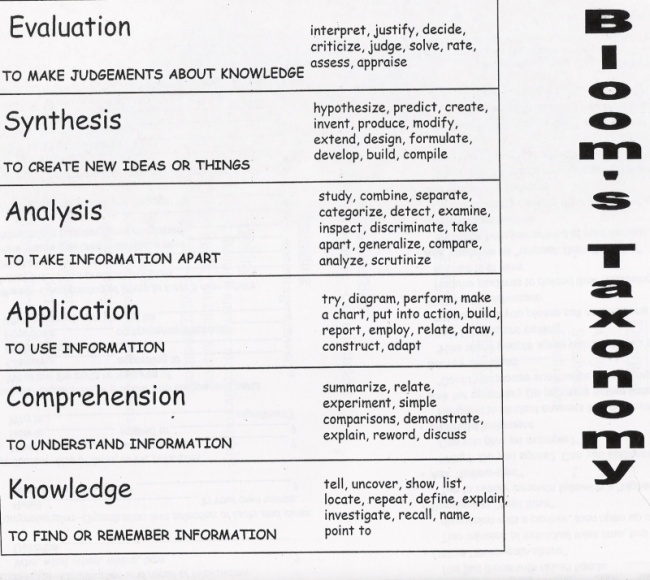

Blooms Verbs

No comments:
Post a Comment